Engine hours: meaning and examples
Engine hours are the total time an engine has run, counted in hours. Tractors, excavators, generators, boats and other machinery are serviced by engine hours because they do work while standing still or moving slowly, which a distance reading does not capture.
How it works
Engine hours count how long the engine has been running, not how far the machine has gone. A tractor ploughing a field, a generator running a site or a boat sitting at a mooring with the engine on can add hours without adding much distance, and that running time is what wears the engine.
Most machines show the figure on a dashboard display or a small counter, usually called the hour meter. Makers of off-road vehicles, lifts, tractors and marine engines write their service intervals in hours for this reason, often alongside a time limit such as "or once a year, whichever comes first".
Cars and bikes are normally serviced by distance. A few makers also treat heavy idling as tough use and shorten the interval, which is the one place a car owner meets the idea of running time.
What hour-based intervals look like in a maker's manual
Polaris's 2022 Ranger 1000 schedule asks for a first service at 25 hours, then every 100 hours, 1,000 miles or once a year, whichever comes first. Honda's 2024 Foreman 4x4 schedule has the first oil change at 100 miles, 20 hours or 1 month, then every 600 miles, 100 hours or 12 months. JLG's ES scissor lift schedule runs five inspection levels, from daily and weekly up to every 100, 200 and 400 hours.
All three are summarised from the maker's own manual on our maintenance schedule pages, with the source linked.
How to track it in Loggy
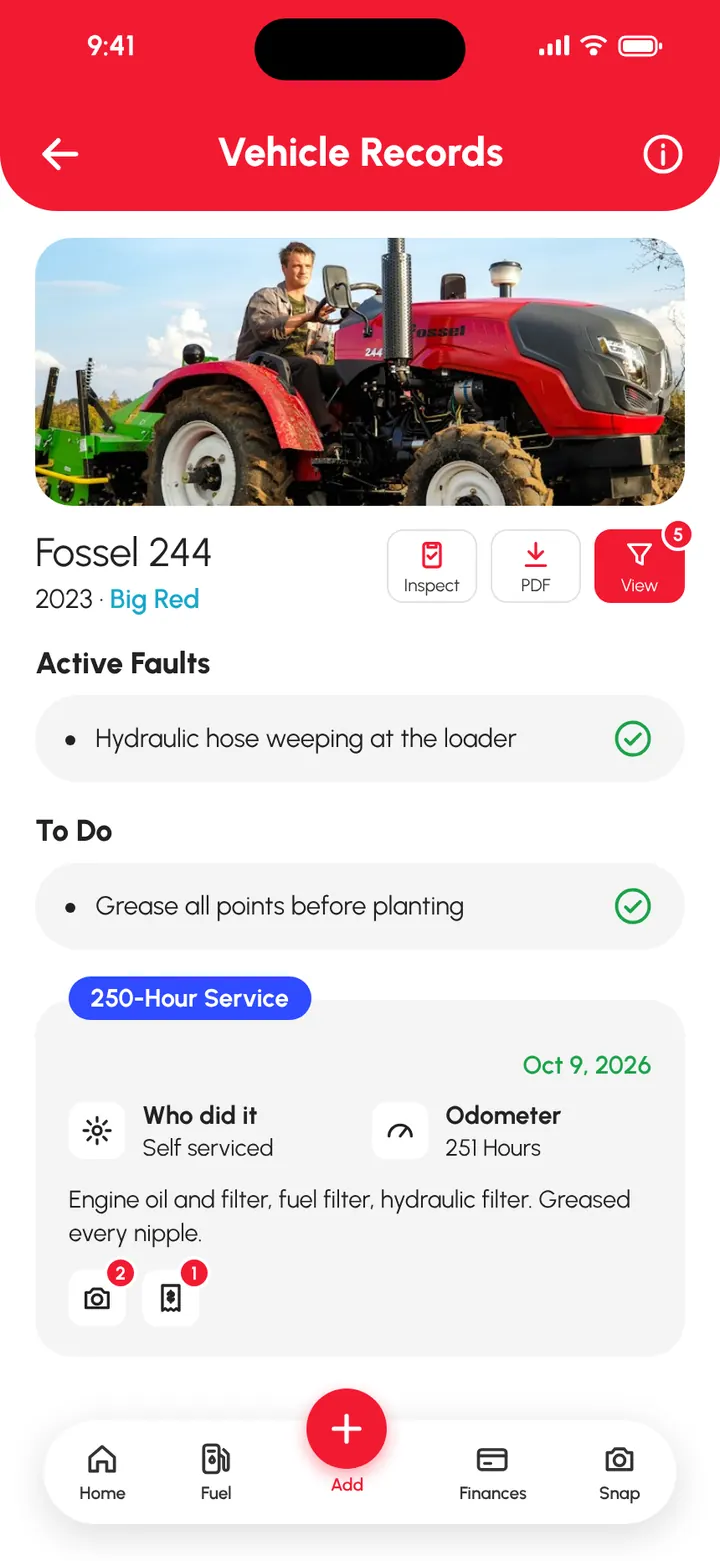
Pick Hours as the unit when you add a machine, then enter the hour reading on each log. Cars and bikes can stay on kilometres or miles in the same app.
- Add the machine in Loggy and choose Hours as its unit instead of kilometres or miles.
- Read the hour meter when you do a service and add a log with that reading, the work done, the cost and any receipt or photos.
- Work out roughly how often you run the machine and set a repeating reminder for the date the next service will fall due. Illustration: a machine used about 10 hours a week reaches 100 hours in roughly ten weeks, so a reminder every 10 weeks is a sensible start. Adjust it whenever your use changes.
Loggy is a free maintenance logbook app for iOS and Android. The free plan has unlimited vehicles, reminders, PDF export and vehicle transfer, and no ads.


Frequently asked questions
What is the difference between engine hours and mileage?
Mileage measures distance travelled. Engine hours measure running time. A machine that works in one place can add many hours and almost no distance, so hours describe its wear better.
Does Loggy remind me when a machine reaches a set number of hours?
No. Loggy reminders go off on a date you choose and can repeat. They do not trigger from an hour reading, so set the date from how many hours you usually run.
Can I track a car or truck in engine hours?
Yes. Loggy lets you choose kilometres, miles or hours for each vehicle, so a work truck that idles a lot can be tracked by hours if that suits you better.
Where do I find the hour reading?
Look for the hour meter on the dashboard display or the engine's own counter. If you cannot find it, the owner's manual shows where it is on your model.